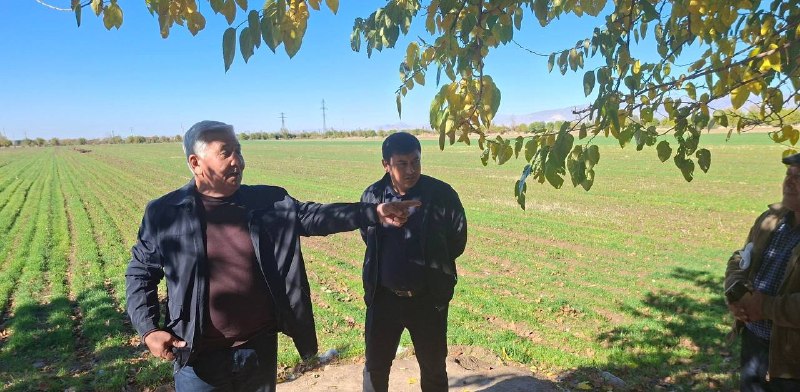

The result of the scientific experiment: the taste of local banana fruits is dominant

The next roundtable discussion organized within the framework of "Driver scientific projects" at the National Center for Knowledge and Innovation in Agriculture was devoted to domestication of tropical fruits through in vitro propagation. The participants of the event exchanged opinions and discussed in detail the scientific and practical advantages of this biotechnology, as well as its economic efficiency.
At the event, Abdurahman Allayarov, head of the Fruit Biotechnology Laboratory of the Research Institute of Horticulture, Viticulture and Winery named after academician Mahmud Mirzayev, gave a speech on the topic "Development of microclonal propagation technology of banana and pineapple plants from introduced tropical fruit crops under in-vitro conditions and organization of nursery."
Abdurahmon Allayarov said that tropical fruits - especially bananas and pineapples - are rich in vitamins and trace elements necessary for human health. It is possible to increase the potential of fruit growing in our country by selecting varieties suitable for the local climate and breeding them through in-vitro technology.
Also, according to Abdurahmon Allayarov, in-vitro microclonal reproduction is not only a high-performance biotechnology, but also an important tool for food safety, ecological stability and acceleration of selection processes. Currently, scientific research is being conducted on banana varieties such as Cavendish, G-9, Tropicana, and a selected sample of pineapple.
The participants of the event were closely acquainted with the stages of sterilization of explants, extraction of virus-free seedlings from meristems, rooting and adaptation to greenhouse conditions.
During the discussion, difficulties in growing tropical fruits, especially bananas, in the climatic conditions of Uzbekistan, scientific approaches and opportunities for their localization were widely analyzed.
It is noted that at the same time intensive work is being carried out in the direction of banana cultivation in Dangara district of Fergana region. In addition, the number of banana growers is increasing in Andijan, Tashkent, Bukhara and Surkhandarya regions.
It was also noted that India is the country that grows the most bananas in the world, and now our businessmen mainly bring banana seedlings from that country. This requires a lot of expenses.
According to experts, if banana seedlings are grown in Uzbekistan using in-vitro technology, it will cost twice as much as importing.
Until now, 500 banana seedlings prepared by the in-vitro method by the institute have been delivered to entrepreneurs as a test. Interestingly, when the harvest from these seedlings was evaluated in terms of taste, it was found that the fruits were sweeter than the varieties brought from India.
At the end of the event, the head of the department of the National Center for Knowledge and Innovations in Agriculture Gafurjon Parpiev made an offer to supply the banana seedlings grown at the scientific institution to entrepreneurs, and introduce them into wide practice.
Subscribe to the official pages of the National Center!
WEB|Telegram| Instagram | Facebook |▶ Youtube