
At the National Center, "Growing of Genetically Modified (Bt) Cotton Varieties, Management of Disease and Pest Resistance, and Highly Effective Indigenous Intensive Agrotechnology...
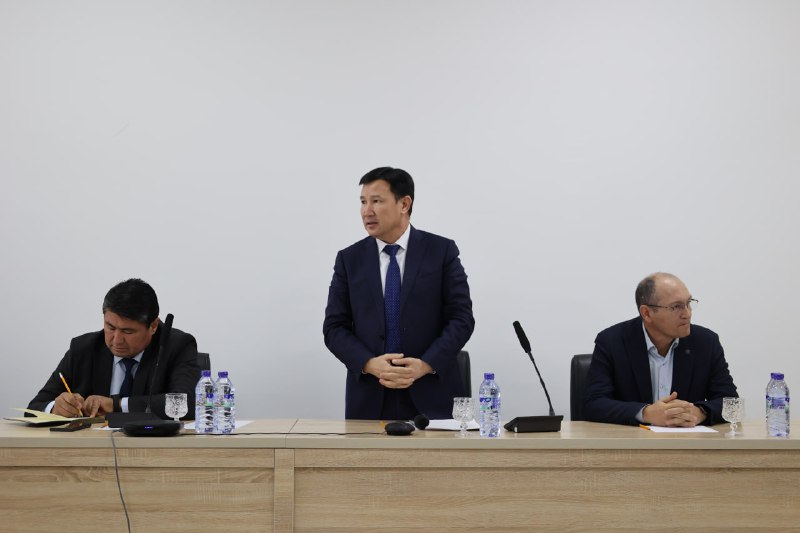
a practical seminar was held on the topic of "implementation".
Shuhrat Otajonov, director of the National Center, Zabardast Boriyev, director's advisor, and Bunyod Mamarahimov, deputy director, made a presentation at the seminar.
In his presentation, Shuhrat Otajonov introduced the seminar participants to the 2025 strategy for the cultivation of genetically modified (Bt)* cotton varieties, management of disease and pest resistance, and introduction of highly efficient local intensive agrotechnology.
The new cotton growing experience for the 2025 harvest includes the following directions.
In this case, the total area of cotton cultivation is:
20 percent - cotton varieties resistant to bollworm and herbicides (Bt) will be placed and maintained using intensive agrotechnology, i.e. drip irrigation under film with 240 thousand seedlings in a 76x10 plot;
in addition, on 20 percent of the area in each region, local cotton varieties are cultivated under a film with the number of 240,000 seedlings in a 76x10 double plot based on highly efficient intensive agrotechnology;
for the remaining 60%, local cotton varieties are planted in accordance with the program of replacing seeds with seeds, taking into account the factors of soil and climate conditions of the regions, salinity, water supply, the ratio of seepage waters, disease "hotbeds" on the basis of a scientifically based seed placement plan. In this case, the 90 cm scheme is completely abandoned.
Geneticist Zabardast Boriyev made a presentation about the importance of BT technology and its features in cotton varieties. The transition to BT technology in the world started in 1996, because this technology was patented, it was not possible to introduce it in our country until that time, we were told that this technology came with foreign selection.
At the end of the meeting, the employees of the regional AKIS and the Scientific-Research Institute of Cotton Selection, Seed and Cultivation Agrotechnologies for the implementation of control of foreign and domestic cotton varieties will be considered mentors and will help in systematic work in this regard on farms.
For information: *Bt-cotton variety is a cotton variety in which Cry genes synthesizing proteins harmful to insects and pests and genes resistant to gliofasat herbicide have been inserted into the genetic apparatus of the plant during the process of genetic modification.
Bollworm resistance is achieved by transferring the genetic material of the soil bacterium Bacillus thuringiensis (Bt) to the plant. The genetic material encodes proteins with specific properties, i.e., toxic to insects and pests, but harmless to mammals and non-target organisms.
Subscribe to the official pages of the National Center!
WEB|Telegram| Instagram | Facebook |▶ Youtube