
SyntheticBiology #Bioethics #HECI #STEM_HECI #ResponsibleInnovation #UNESCO #PublicInterestTechnology #SustainableScience
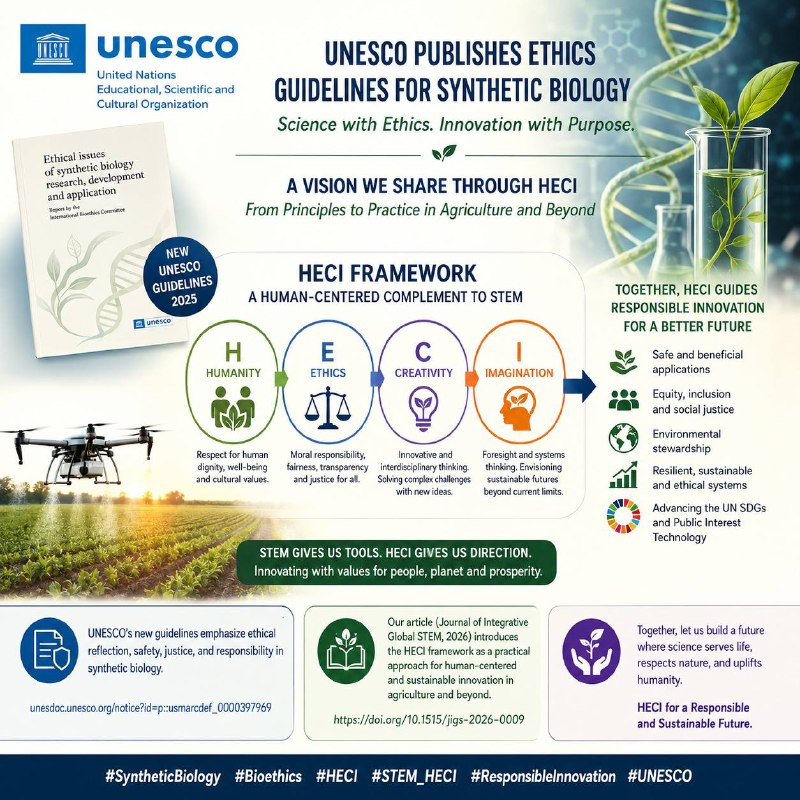
The publication of ethical guidelines for synthetic biology by UNESCO is a very important and timely initiative. Synthetic biology opens up great opportunities for agriculture, medicine, food security, climate resilience and the bioeconomy.
At the same time, it also puts on the agenda such deep questions as biosecurity, justice, human dignity, environmental responsibility and the benefit of future generations.
This approach is directly aligned with the concept of HECI—Humanity, Ethics, Creativity and Imagination—proposed in our Journal of Integrative Global STEM article.
Our paper proposes HECI as an approach that enriches STEM education and innovation with humanity, ethics, creativity, and the ability to envision the future.
STEM allows us to engineer and modify living systems.
And HECI reminds us that these opportunities must be safe, fair, inclusive, environmentally responsible and in the public interest.
Biotechnology of the future is only about "what can we do?" not with the question "what should we do and with what responsibility?" should be guided by the question.
STEM gives us the tools. And HECI gives direction.
UNESCO report: https://unesdoc.unesco.org/notice?id=p::usmarcdef_0000397969
Our article: https://doi.org/10.1515/jigs-2026-0009
English
UNESCO's publication of ethics guidelines for synthetic biology is a timely and important step. Synthetic biology offers major opportunities for agriculture, medicine, food security, climate resilience, and the bioeconomy. At the same time, it raises profound questions about biosafety, fairness, human dignity, ecological responsibility, and the rights of future generations. (https://unesdoc.unesco.org/ark:/48223/pf0000397969)
This strongly resonates with our recently published article in the Journal of Integrative Global STEM, where we introduced the HECI framework — Humanity, Ethics, Creativity and Imagination — as a human-centered complement to STEM for responsible and sustainable agricultural innovation.
STEM gives us the power to design and transform living systems.
HECI reminds us that such power must be guided by safety, justice, inclusion, ecological responsibility, and the public good.
The future of biotechnology should not be shaped only by the question "What can we do?" but also by "What should we do, and with what responsibility?"
STEM gives us tools. HECI gives us direction.
UNESCO report: https://unesdoc.unesco.org/notice?id=p::usmarcdef_0000397969
Our article: https://doi.org/10.1515/jigs-2026-0009